
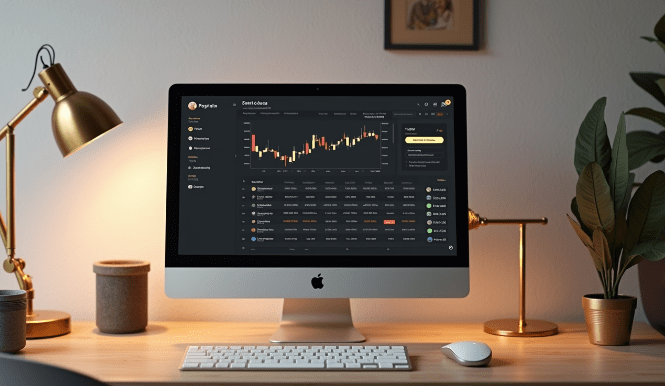
If you’re stepping into the world of investing or looking to upgrade your current brokerage setup, there’s one decision you can’t afford to overlook: your trading platform. It’s the vehicle through which every investment decision is executed, every chart is analyzed, and every asset is acquired. Choosing the wrong platform can slow you down, frustrate your process, or cost you more money than you’re willing to give.
This guide cuts through the noise to compare the most trusted trading platforms out there, from beginner-friendly interfaces to advanced terminals. I’ll examine what actually matters when picking a platform, then match the best options to different investor levels.
What You Should Look Out For in a Trading Platform
At first glance, many platforms seem similar, with zero-commission trades, mobile apps, some research tools. But, digging deeper makes the differences are clear. The most important factors to look at include:
- Fees and Commission Structure: Most brokers no longer charge for U.S. stock or ETF trades, but options, futures, and margin trading still carry costs that can add up fast
- Account Requirements: Minimum deposit thresholds, inactivity fees, and membership plans can limit who a platform is really for.
- Available Assets: If you’re looking to invest beyond the basics, make sure your platform offers access to crypto, international markets, options, and other asset classes.
- Technology and Tools: The more active or advanced your trading style, the more you’ll need reliable execution speed, customizable charts, and advanced analysis tools.
- Education and Research: Beginner and intermediate investors especially benefit from platforms with high-quality tutorials, guides, and in-depth market research.
- Customer Support and Reliability: When markets are volatile, platform outages or slow response times can be costly.
Keeping these factors in mind, let’s walk through some of the best platforms available today and break down what they do best and where they fall short.
Fidelity Investments
Fidelity leads in overall quality for long-term investors. It charges $0 for stock, ETF trades and $0.65 per options contract. There are no account minimums and no maintenance fees.
It also offers excellent cash management with uninvested funds earning around 3.94% as of 2024, and top-tier research powered by independent providers like Zacks and Morningstar.
Pros:
- Great research tools and an investor-focused approach
- High interest on uninvested cash
- No payment for order flow
- No minimums or inactivity fees
Cons:
- No direct access to cryptocurrencies
- Some mutual funds and ETFs may carry fees outside of Fidelity’s no-cost list
thinkorswim (by Schwab)
Originally developed by TD Ameritrade, thinkorswim is now fully part of Schwab and stands as one of the most powerful platforms available for advanced traders. The software is free to use, and it supports highly customizable charting, options modeling, paper trading, scripting with thinkScript, and access to futures and forex.
You’ll need approval for options, futures, or margin trading, but once you’re in, it offers one of the richest toolsets on the market.
Pros:
- Advanced charting and strategy testing
- Custom scripting tools
- Paper trading for practice and testing
- No added cost for platform use
Cons:
- Steep learning curve
- Overkill for long-term or casual investors
Interactive Brokers (IBKR)
IBKR is a heavyweight platform geared toward advanced traders and global investors. It offers $0 commission on U.S. stocks and ETFs, but options trading costs around $0.65–$0.85 per contract, depending on volume. Futures cost between $0.25 and $0.85 per contract.
There’s no minimum to open an account on IBKR Lite, though IBKR Pro (for professionals) waives its $10 monthly fee only with a $100k balance or regular trading activity. It also boasts the lowest margin rates in the industry, powerful algorithmic trading capabilities, and access to over 150 international markets.
Pros:
- Global market access and broad asset support
- Best-in-class margin rates
- Extremely advanced research and automation tools
- Professional-level execution
Cons:
- Interface is not beginner-friendly
- Learning curve is significant even for experienced investors
tastytrade
tastytrade is built for traders who prioritize options and simplicity. It charges a flat $1 to open options trades (no closing fee), and stock/ETF trades are free. There’s no account minimum and no platform fee.
Its standout feature is a visual interface that simplifies complex options strategies. Educational content is built into the experience, with daily livestreams and a library of lessons made for active traders.
Pros:
- Flat, low-cost pricing for options
- Visual tools for strategy-building
- Great educational content and livestreams
- Strong community engagement
Cons:
- Limited in terms of non-options research and tools
- No support for mutual funds, bonds, or cryptocurrency
Webull
Webull targets intermediate traders with a sleek, app-first interface, commission-free trading, and surprisingly deep technical analysis tools. It offers free trading for stocks, ETFs, and options, and 24/7 crypto trading with small spreads instead of fixed fees.
There’s no minimum deposit, though margin accounts and options trading require approval. It lacks retirement accounts and mutual funds, but it offers enough features to satisfy most DIY traders looking to grow their skills.
Pros:
- Great for technical traders
- No trading commissions or platform fees
- Offers crypto and extended-hours trading
- Fully mobile-optimized
Cons:
- Weak educational resources
- No retirement accounts or mutual funds
- Not ideal for fundamental research
Robinhood
Robinhood helped normalize commission-free investing, and its minimalist mobile interface makes it a great entry point. Stock, ETF, options, and crypto trading are all free. For $5/month, Robinhood Gold adds benefits like larger instant deposits, Morningstar research, and a 2.5% margin rate.
There’s no minimum deposit required, but you’ll need approval for options and margin trading. Robinhood also supports fractional shares and recurring investments.
Pros:
- Extremely easy to use
- All major asset classes supported, including crypto
- No commissions or platform fees
- Supports fractional shares and recurring buys
Cons:
- Limited tools and research
- History of platform outages and PFOF controversy
- Few advanced features or asset types
E*TRADE
E*TRADE has long been a respected name in online trading. It offers $0 commissions for stocks and ETFs, $0.65 per options contract, and $1.50 for futures. There’s no account minimum for brokerage accounts, and it supports IRAs, 529 plans, and other tax-advantaged vehicles.
Its Power E*TRADE platform includes strong charting and risk analysis for active traders, while its standard platform is great for long-term investors.
Pros:
- Full-featured platform for all investor types
- Strong educational and planning resources
- Good customer support
- Options and futures support
Cons:
- No cryptocurrency access
- Interface can feel dated in places
So, Which Platform Is Best?
For beginners, Fidelity and Robinhood are excellent starting points. They’re simple, easy to use, and offer just enough for investors to start. Fidelity goes further with it’s research and learning tools, but both work great regardless.
For intermediate investors, Webull and ETRADE strike the right balance. Webull is great for those who want to level up their charting and trading speed, while ETRADE delivers a reliable, well-rounded experience with multiple account types and planning tools.
For advanced traders, Interactive Brokers and thinkorswim are unmatched. IBKR is the go-to for algorithmic, global, and margin trading. Thinkorswim provides a rich, customizable toolkit for options, futures, and technical analysis.
Final Thoughts
You don’t need the “best” platform, you need the right platform for you. Choose one that fits your goals, your knowledge level, and the assets you want to trade. And remember, you can always change platforms as your skills and needs evolve. Start smart, stay curious, and invest in the tools that help you grow.
Sources
 Investing IQ
Leave a comment