
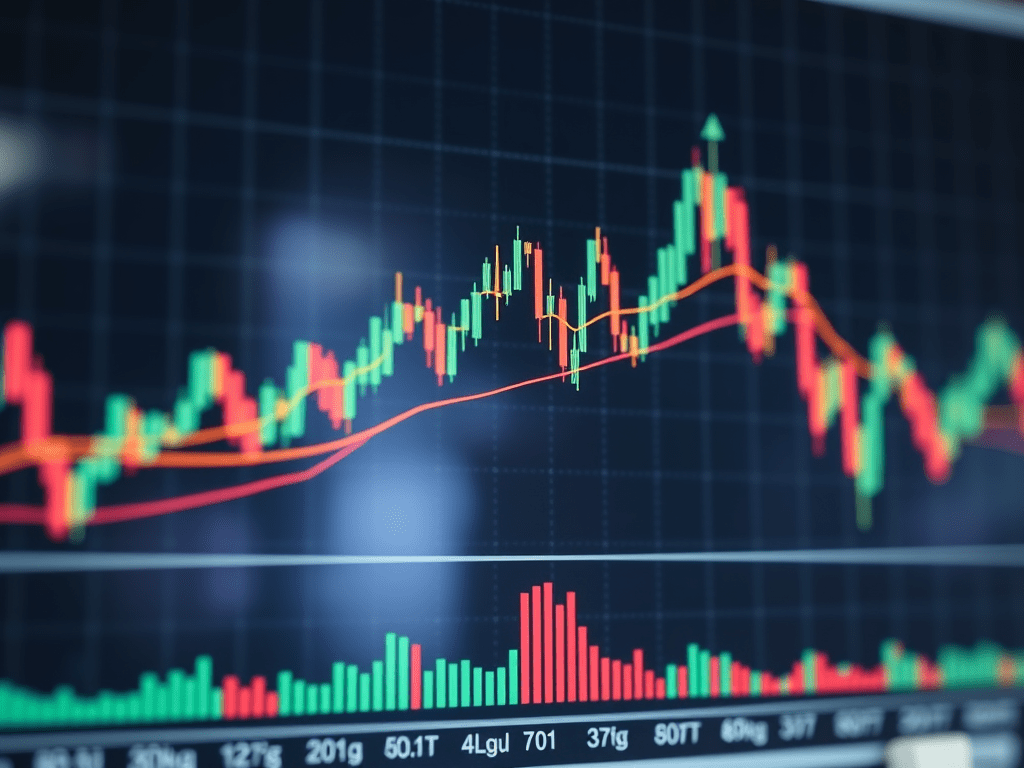
Technical Analysis is a helpful chart analysis tool essential for understanding successful trading. For new investors, technical analysis can seem reserved for day traders. However, learning the basics of this type of analysis can give you a serious edge in understanding market trends and timing your trades smartly. In this post, we are going to review several indicators to help you get started with the basics.
Moving Averages
Among the simplest and most useful indicators, moving averages are a reliable tool that smooths out price data over a set period, revealing the underlying trend. This effectively removes the ‘noise’ from daily price swings, giving you a clear picture of the market.
There are two main types, the Simple Moving Average (SMA) and the Exponential Moving Average (EMA). The former is the average closing price of a stock over a specific period (like 50 or 200 days), while the latter gives more weight to recent prices, making it more responsive and accurate to new trends.
As investors, we use moving averages to identify whether a stock is trending up or down. A popular strategy is the crossover method, which is when a short-term average (like the 50-day) crosses over a long-term average (like the 200-day). This could signal a buying or selling opportunity, otherwise known as a Golden Cross (if the 50-day crosses above the 200-day) or a Death Cross (if the opposite occurs). A cross in moving averages is meaningful because it tells us that short-term momentum has gained enough strength to overcome the longer trend in a stock, which is key to finding a good entry/exit point.
Relative Strength Index (RSI)
The Relative Strength Index, or RSI, measures the size of recent price movements to reveal if a particular stock is overbought or oversold. It’s expressed on a scale from 0 to 100. Interpretations can vary depending on strategy, but a good general rule is that when it’s above 70, the stock may be overbought and potentially due for a pullback. At the same time, if it’s below 30, it may indicate that it’s oversold and poised for a rebound.
RSI is especially valuable if you’re trying to spot potential turning points in a stock’s trend. For instance, if a stock price has been declining for some time and the RSI falls below 30, it might signal that selling pressure is easing and buyers could soon step in. But, like with any other technical indicator, RSI shouldn’t be relied on alone. Things like broader market sentiment, economic news, and company-specific developments all override what the charts suggest, so it’s best used as one piece of a larger puzzle.
Volume
Volume shows how many shares are traded over a given period. It’s not just a background number, but an insight into the strength driving price movements. If a stock breaks out of a resistance level on high volume, the move is more likely to be real and sustainable. If volume is low during a price move, it may lack conviction and could quickly reverse.
Analyzing volume alongside price movements on candlestick charts can help you identify support and resistance levels, which act as “barriers” where the price tends to stop its momentum. Take this scenario for example: Let’s say you’re interested in investing in CVS but are waiting for a good entry point. Suppose you look at past price points, and there are many instances where CVS’s stock dips to $50 and trading volume spikes at that level due to strong buying interest. In that case, it suggests that $50 is acting as support. This means buyers consistently step in at that price, preventing it from falling further. So, if the price approaches $50 again and holds, especially with strong volume confirming buying interest, it could be a good entry point for you to invest. But remember, this must also be in tandem with other indicators to support the trade.
One Last Note
While technical indicators are undoubtedly helpful, it’s crucial to remember that they should be used as a final step in your decision-making process. Your first step should always be thorough research on the stock, analyzing its fundamentals, and waiting for catalysts. As I’ve emphasized in other posts, technicals help you decide when to invest, but they don’t tell you what to invest in. This approach will make you a responsible and informed trader.
Also, these indicators are just a few to get started with, and there are so many more out there, so if you would like another post going more in-depth, please let me know in the comments!
Sources
 Investing IQ
Leave a comment