
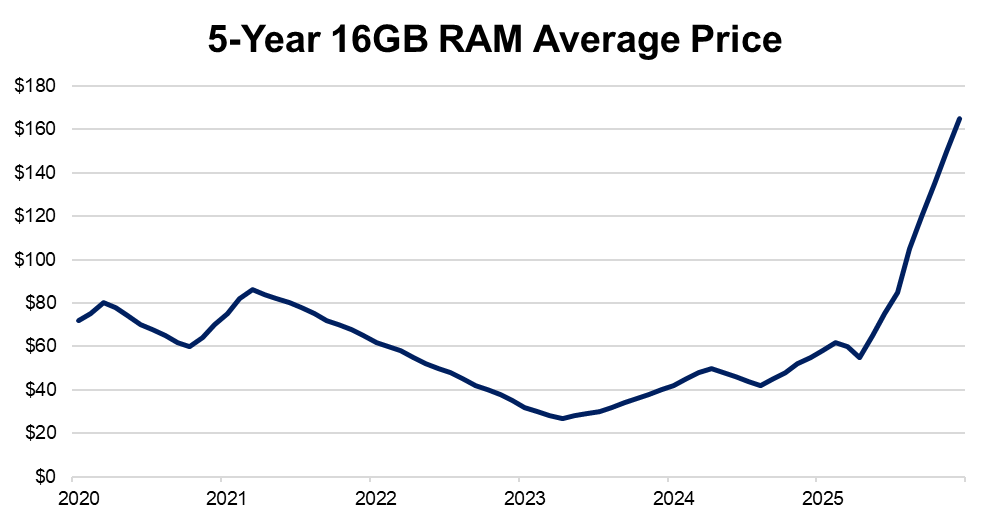
There’s been a significant surge in demand for memory (DRAM) that has far outpaced supply, with the AI Boom taking the lion’s share of the blame. Some of the biggest companies in the world, like Google, Nvidia, and AMD need immense amounts of DRAM capacity to support the development and success of their AI chips, as these chips need to store, process, and access billions of parameters and datapoints to create rapidly intensive responses. The rush of investment from these companies and more has caused prices to skyrocket. Moreover, the increasing focus on creating HBM (High Bandwidth Memory) for Nvidia rather than traditional RAM hardware is also contributing to the shortage, as they take up much more space and result in fewer overall units being made. 2 sticks of 16GB RAM around 7 months ago would’ve run you $150. Now, those same two sticks are around $280-320, an ~87-113% increase. But why now? We saw largescale AI development and investment for most of 2025, but the reason prices have spiked in the past two months has to do with inventory reaching critical levels with more massive orders being made. Then Samsung, back in December, raised their contract prices by another 100%, causing customers to buy more in anticipation of future price hikes, which in effect made the problem worse.
Implications for the Market
Samsung, Micron, and SK Hynix collectively make up over 90% of the global DRAM market, and they’re benefitting immensely from this surge in demand, with their stock prices jumping 201%, 311%, and 331% in the past year respectively. Samsung also reportedly expects their operating profit to triple for Q4. As for what this means for the rest of the market, DRAM is used on some level in virtually every electronic product that exists, meaning there would be large effects on costs for electronics manufacturers and likely consumers at large in the near future. The question is, how much of a margin hit are companies willing to take before they pass on costs to consumers? I’m not planning on paying $100+ more for the same phone, laptop, or gaming console. However, this alludes to a larger issue at play, which is how the investment and development of AI is completely reshaping the landscape of input costs (both directly and indirectly) in the broader market. AI hasn’t just played a part in DRAM spiking, but also in silver, copper, lithium, electricity, freight (as data center parts take up large spaces), and more. It comes to a point where we need to ask ourselves if this is sustainable, but then again, nothing stops progress.
 Investing IQ
Leave a comment