
What Happened
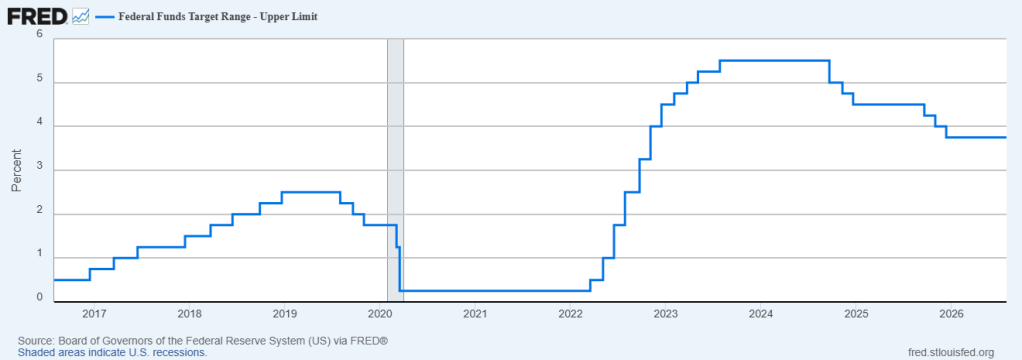
The Fed held its benchmark rate steady at 3.50% to 3.75% on July 29, extending a pause that’s now stretched the entire year. But there was a split behind that decision. Three regional presidents dissented in favor of a 25 basis point hike. That’s the first time since September 2016 that three FOMC members have dissented in the same direction, and it signals a committee that’s no longer in consensus on simply waiting out inflation.
Chair Kevin Warsh, in his first cycle running these meetings, kept the post-meeting statement short, consistent with his stated preference for cutting back on forward guidance. He’s also framed inflation as “a choice,” language that suggests he sees the persistence above target as more of a policy failure than a transitory shock. The split in the Fed and language of the Fed chair pushed the 10-year yield up 5 basis points to 4.657%.
Macroeconomic Backdrop
The setup here is a Fed stuck between two uncomfortable signals. Growth still looks fine on paper. The Committee’s own language points to solid economic activity, strong productivity and capital investment, and a job market that’s kept pace with the labor force without much movement in the unemployment rate. That’s normally a positive.
However, it’s not as promising in combination with the real problem: Inflation. It’s been above the 2% target for more than five years now, and the immediate concern is energy. Oil prices have been volatile on the back of the U.S.-Iran conflict, and crude is up more than 20% for the month of July alone, which is going to keep headline inflation prints hot.
My Takeaway
The Fed is in a strange spot right now, and I think holding rates was the correct call, even with three dissents pushing for a hike.
The Core CPI cooled to 2.6% YoY in June, down from 2.9% in May, and came in flat on a monthly basis when economists expected another 0.2% increase. That’s broad deceleration.
I will grant the obvious criticism. Excluding food and energy puts a limitation on the relevance of Core CPI because those are costs people actually pay every week. But that same exclusion is what makes Core CPI useful as a diagnostic tool. When you see the underlying energy trend cooling while headline inflation remains elevated, you are seeing that the overall inflation problem is an energy problem right now, not an economic one. Headline CPI fell to 3.5% YoY from 4.2% in May largely because energy prices dropped 5.7% in a single month, the largest drop since 2020, on the back of easing tensions in the Iran conflict.
If core inflation were still climbing alongside headline, that would tell you the economy is too hot. But that’s not happening. Instead, we see a geopolitical shock to energy markets that is showing up in every economy on the planet that imports oil, not something specific to how the U.S. economy is being run. Hiking rates to fight an energy-driven headline number would mean tightening policy to solve a problem that higher interest rates can’t actually fix. You can’t raise rates and make a barrel of oil cheaper.
So I think the hold was right given where the data sits today. But I want to be clear that this is a conditional position. If the Iran conflict stays unresolved and energy prices reaccelerate, and if that starts feeding back into core categories rather than staying contained to energy, then a rate hike becomes necessary. Headline inflation at 3.5% is not an acceptable resting point, regardless of the cause, and every month it remains elevated is another month it weighs on consumers. The Fed’s patience is only justified as long as the composition of inflation continues to point at energy rather than the broader economy. The moment that story changes, the case for holding changes with it.
Disclaimer:
This blog post is for educational and informational purposes only. It is not financial advice. I am not a licensed financial advisor, and nothing in this post should be interpreted as a recommendation to buy or sell any securities. Trading involves risk, and results are not guaranteed. Past performance is not indicative of future results. Always do your own research and consult with a licensed financial professional before making any investment decisions. None of my statements or points of view are reflective of the views of Deep Knowledge Investing.


Leave a Reply