
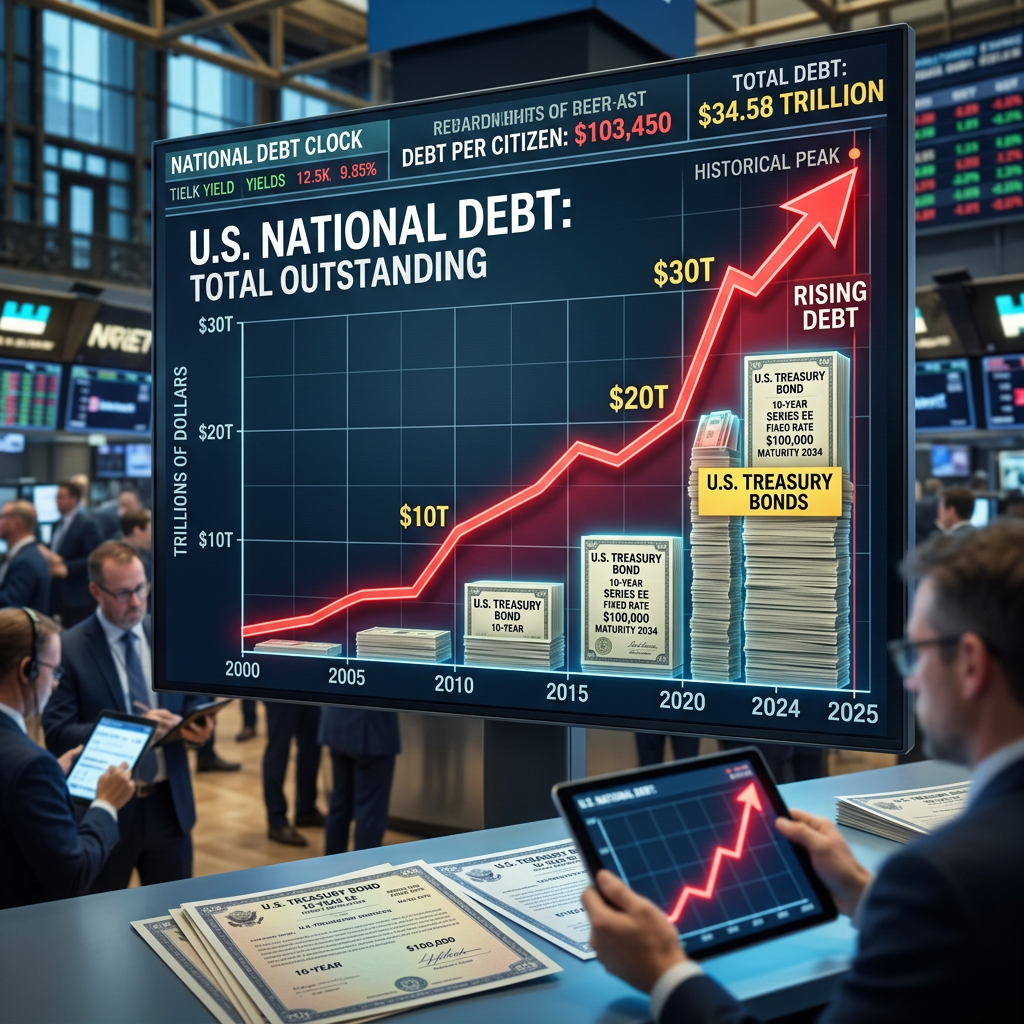
If you asked most people about the national debt, they’d respond with a sense of negativity, saying it’s simply not good for the nation. But if you asked why that is, I doubt many would understand the reinforcing cycle the government finds itself in.
Where Our Debt Comes From
When the government spends more than it earns (tax dollars), we end up in a deficit that grows over time.
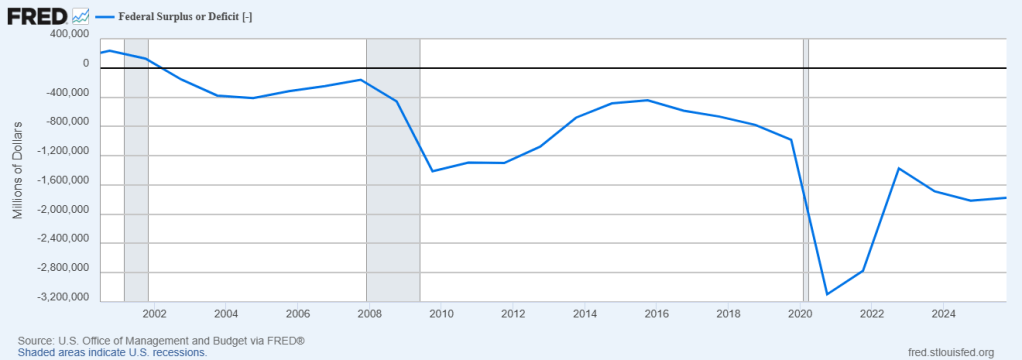
In the FRED graph above, you can see that the federal government hasn’t had a surplus in quite some time.
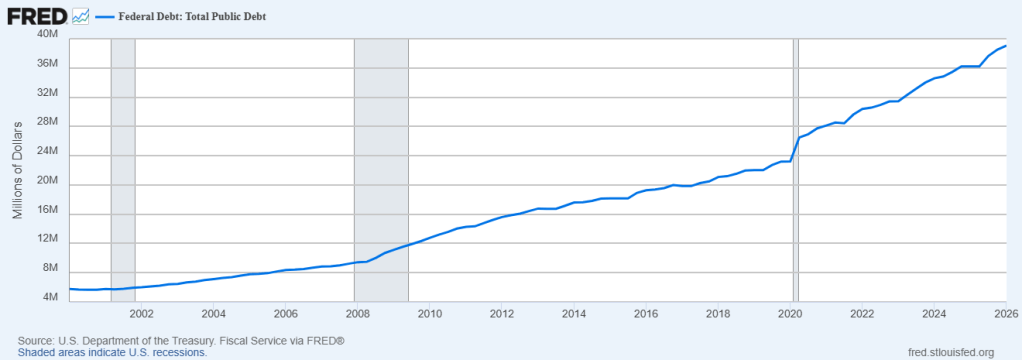
And here, you can see that it aligns with how the total debt moves. When we spend in a deficit, the US government has to issue more treasury/debt securities to finance it. More deficits mean more issuance of bonds, leading to higher interest payments on our debt.
These securities are commonly bought by other countries, which is why you may have heard about other countries “owning” or “holding” US debt. One of the biggest, for example, is Japan.
Why This is Problematic
As our deficit spending continues, more bonds are issued to finance the difference. But over time, as deficits get larger and more bonds are issued, the supply increases. This tanks their value, and value and yields are inverse. So to prevent very high yields on the bonds (and therefore other interest rates across the economy), demand must increase enough to help steady them.
This is where the Federal Reserve comes in. Up until a few years ago, the Fed ran Quantitative Easing, where it was buying up securities from the government to decrease the supply out there. To do this, it created more money, which increases the money supply and leads to the debasement of our currency. Debasement creates inflation.
Note: After 2022, it ran Quantitative Tightening to decrease the money supply. QT officially ended in December 2025, and the Fed has since begun buying Treasury bills again to maintain ample bank reserves. This is a return to what some are calling “technical QE.” Take the QE cycle described above as the long-term trend, interrupted by a multi-year QT stretch (2022-2025) where the Treasury had to lean more heavily on private and foreign buyers to absorb issuance. This reliance is part of why yields climbed even as the Fed cut rates during the latter stages of that window.
No matter what the Fed does, there’s a chunk of inflation that it can’t do anything about, since debasement is its driver.
The Cycle
More inflation means higher yields over time, which means the interest payments of the US government keep increasing on every security it issues. So, interest will take up larger chunks of the budget, and since the government can’t agree on how to spend less, the deficit spending gets worse. This repeats the cycle over time, leading to more inflation, higher interest, constraints on government programs, and possible credit rating downgrades (which we’ve already seen).
However, there are nuances, such as the debt-to-GDP ratio. If GDP keeps growing at a rate greater than the average interest rate on the debt, that’s a positive sign for sustainability. This would lower the ratio. Greater GDP is normally associated with more taxable income for the government (not 1:1; there are nuances over where the GDP growth comes from). However, if the ratio increases, then interest expense becomes heavier relative to income, causing more risk and prompting investors to demand higher yields (Nominal GDP growth is around 6.5%, while the average interest rate is around 3.5%. This is positive, but shifting as the interest climbs higher).
This, along with greater inflation, is what drives the higher yields and leads to the cycle I was talking about before.
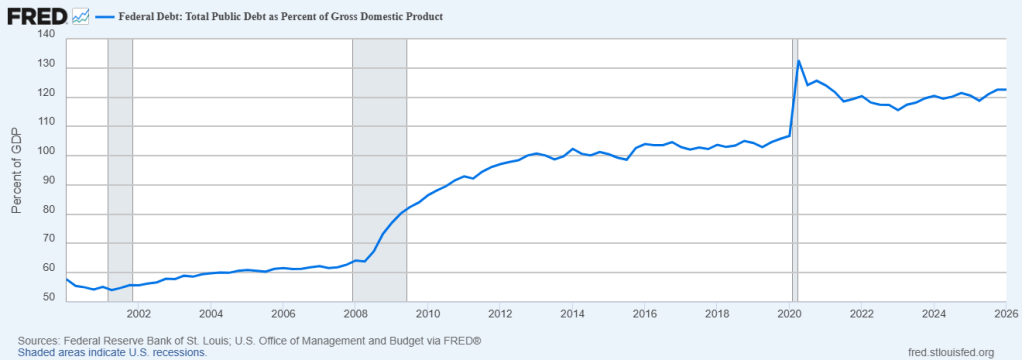
The above graph illustrates this. Since the COVID spike, the ratio has held relatively flat, but over the long-term, it’s been going in one direction.
What Can Be Done
To be honest, the way things stand, it doesn’t seem as though much can be done. Solutions exist, but they’re very difficult to get people to agree on.
The most obvious solution is to cut spending. Cutting military spending might prove effective. However, most Republicans wouldn’t stand for that. The other option is to cut social welfare, which Democrats would revolt against.
Another possibility is increasing taxes, but the American public would have a problem with that too. Plus, no politician would want to risk re-election by proposing that.
The last solution is simply growing GDP. More business success and profits cycle back to salaries and wages. This increases taxable revenue. But GDP that comes from direct government involvement would be the wrong way to do it, as investments mean more spending, which loops back into more deficits.
The bottom line is that this cycle is a larger issue than most people realize. Unless growth continues to outpace rates, inflation and interest rate risk will keep rates elevated, stressing the US government more and more.
Disclaimer:
This blog post is for educational and informational purposes only. It is not financial advice. I am not a licensed financial advisor, and nothing in this post should be interpreted as a recommendation to buy or sell any securities. Trading involves risk, and results are not guaranteed. Past performance is not indicative of future results. Always do your own research and consult with a licensed financial professional before making any investment decisions. None of my statements or points of view are necessarily reflective of the views of Deep Knowledge Investing.


Leave a Reply