

The Foreign Exchange (or ForEx) refers to the international currency markets and the relationships of currencies to each other. You’ve probably seen a green or red arrow on the news with no explanation for why it moved. In this post, I’m going to dive into what ForEx is, how it changes, and why it matters.
How It Changes
The change comes down to a concept everyone understands: supply and demand.
Take USD-JPY. Demand for a currency is driven by foreign buying. When bond yields rise, foreign investors want more of those bonds, so they exchange their currency for dollars, pushing the dollar’s value up. Supply is controlled by how many dollars are in circulation, which the Federal Reserve manages (just as the Bank of Japan manages the Yen).
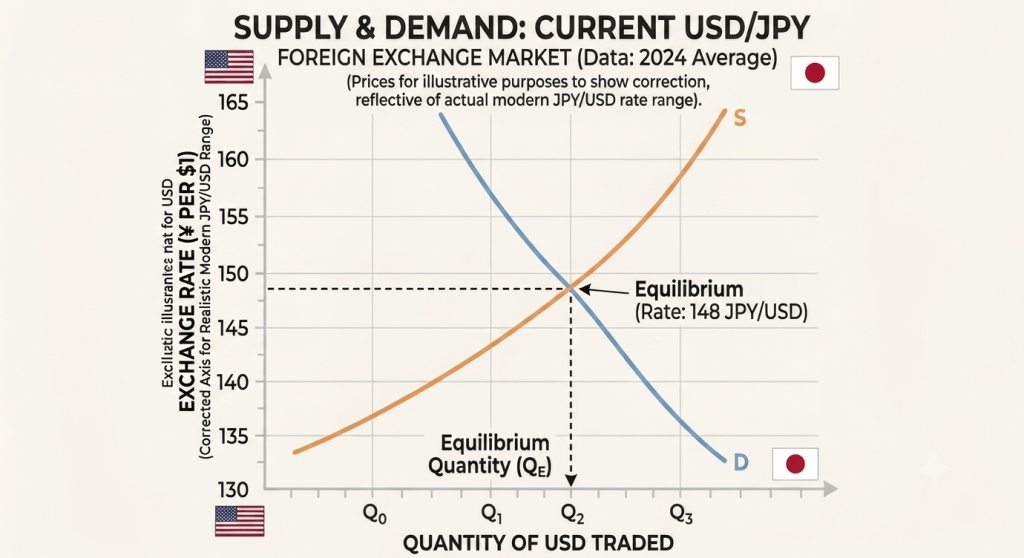
These dynamics create a larger web of effects. Greater inflation erodes the real return on bonds, so investors demand higher yields to compensate. Those higher yields then pull capital back in, which is what balances out the initial weakening. Geopolitical tension works differently. During uncertainty, investors flock to the dollar as a safe haven since it’s the world’s reserve currency, causing it to appreciate.
What It Affects
ForEx affects the purchasing power of your wallet, from groceries to imported technology. It also moves commodity markets. Since gold is priced in dollars, a stronger dollar makes it more expensive for foreign buyers, pushing prices down. Oil works the same way, which is part of why it’s so sensitive to dollar movements on top of the usual drivers like OPEC output decisions.
It also hits corporate earnings. Any US company with overseas revenue is exposed to currency risk. When the dollar is strong, foreign earnings are worth less when converted back. You’ll hear this called a “foreign exchange headwind” on earnings calls, and it can drag on results even when the underlying business is doing well.
The Dollar in Action
USD-JPY is a good real world example. The Bank of Japan kept rates near zero while the Fed hiked, causing investors to borrow Yen at low rates and buy higher-yielding dollar assets. When the Bank of Japan started hiking in 2024, that trade unwound fast. Dollar assets were sold and Yen loans were repaid, causing the Yen to spike back up.
There’s also the DXY, which measures the dollar against a basket of major currencies. A strong dollar cuts both ways. Exporters suffer because their goods become more expensive abroad, and multinationals take a hit converting overseas earnings back to dollars. Add in political risk from fiscal policy and tariff concerns, and the dollar’s safe haven status is facing more scrutiny than at any point since the 2008 financial crisis.
These examples are why ForEx matters. It’s not an abstract number on a screen, it’s the mechanism connecting central bank policy, corporate earnings, and commodity prices into one number you can watch move in real time.
ForEx is a real-time scoreboard for how the world feels about a country’s economy. Learning to read it gives you an edge in understanding what’s driving markets on any given day.
Disclaimer:
This blog post is for educational and informational purposes only. It is not financial advice. I am not a licensed financial advisor, and nothing in this post should be interpreted as a recommendation to buy or sell any securities. Trading involves risk, and results are not guaranteed. Past performance is not indicative of future results. Always do your own research and consult with a licensed financial professional before making any investment decisions.


Leave a Reply