
A little over a week ago, I was asked to pitch a long/short on a 20+ Year Treasury Bond ETF for a case study. I pitched short in the face of a soft PCE, and along with other factors, one of my catalysts was the market’s inaccurate expectations on inflation.
Fortunately (or unfortunately, depending on your perspective), I turned out to be right.
What You Missed
The headline CPI came above expectations at 3.7% YoY and 0.6% MoM, the largest month-over-month increase in 5 months. Core CPI was up 2.6% YoY and 0.3% MoM. According to the BLS, YoY Oil and Gas are up 74.2% and 34.2%, respectively. Airlines are up 22.4% as jet fuel costs are passed on to consumers. That’s the piece pushing the Core number up, as it excludes food and energy but not airfares.
Food and groceries are also up between 4-6% depending on the category, but I’d expect higher import costs (fuel-related) are driving those. Overall consumer demand has also been strong despite flat wages, allowing prices to remain higher without being punished by lower demand.
The last PCE came in lower, indicating to some in the market that inflation was slowing. However, part of that was the BEA changing its weightage in measuring it, along with a lack of accounting for the September spike in crude.
Below is the spot price of crude.
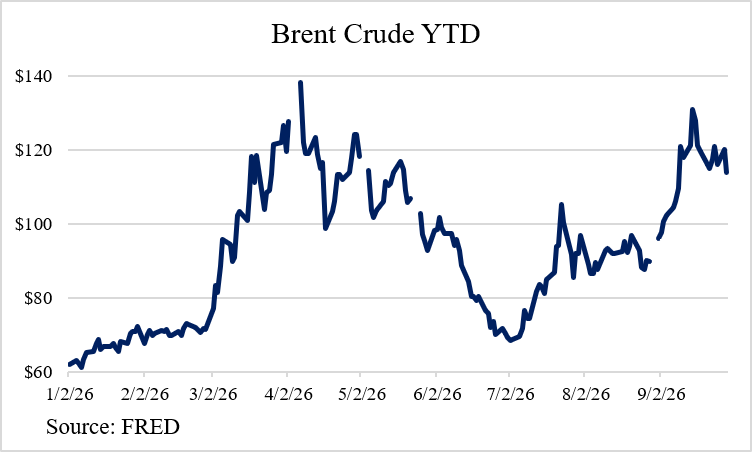
September saw a huge spike that wasn’t accounted for until this last CPI. I expect the same will be true for the PCE.
My Takeaway
I expect the Fed to hike and, once again, have little impact on inflation. I think the market feels better every time they do, but beyond the messaging, it’s tough to expect any real impact to trickle through the system. It’s a tough spot to be in, and not something they caused.
The recent bank earnings will tell you that higher rates are putting pressure on credit, with more reserves being held to hedge against default risk. However, the broader issue is that a slowdown in the domestic economy is not going to be well represented in the CPI. Shelter is the biggest piece, making up ~30% of the CPI (42% of Core CPI), which would imply that a drop in housing prices should do the trick. However, the BLS measures it using OER. Explaining OER would be its own article, but the bottom line is that it lags 1+ years behind current data and is smoothed out (meaning even though inflation is low in housing right now, OER overstates it). This materially overstates the CPI, meaning a domestic slowdown outside of it wouldn’t be enough to change the CPI or, by extension, policy direction.
Even though core CPI was not alarmingly high, I’d still expect a hike either at the next FOMC meeting or the one after that. Inflation cannot be this high, and with no end in sight to the Iran conflict, it continues to be. Even if they don’t, it likely won’t matter, as the bond market will price it in.
Disclaimer:
This blog post is for educational and informational purposes only. It is not financial advice. I am not a licensed financial advisor, and nothing in this post should be interpreted as a recommendation to buy or sell any securities. Trading involves risk, and results are not guaranteed. Past performance is not indicative of future results. Always do your own research and consult with a licensed financial professional before making any investment decisions. None of my statements or points of view are necessarily reflective of the views of Deep Knowledge Investing.


Leave a Reply