
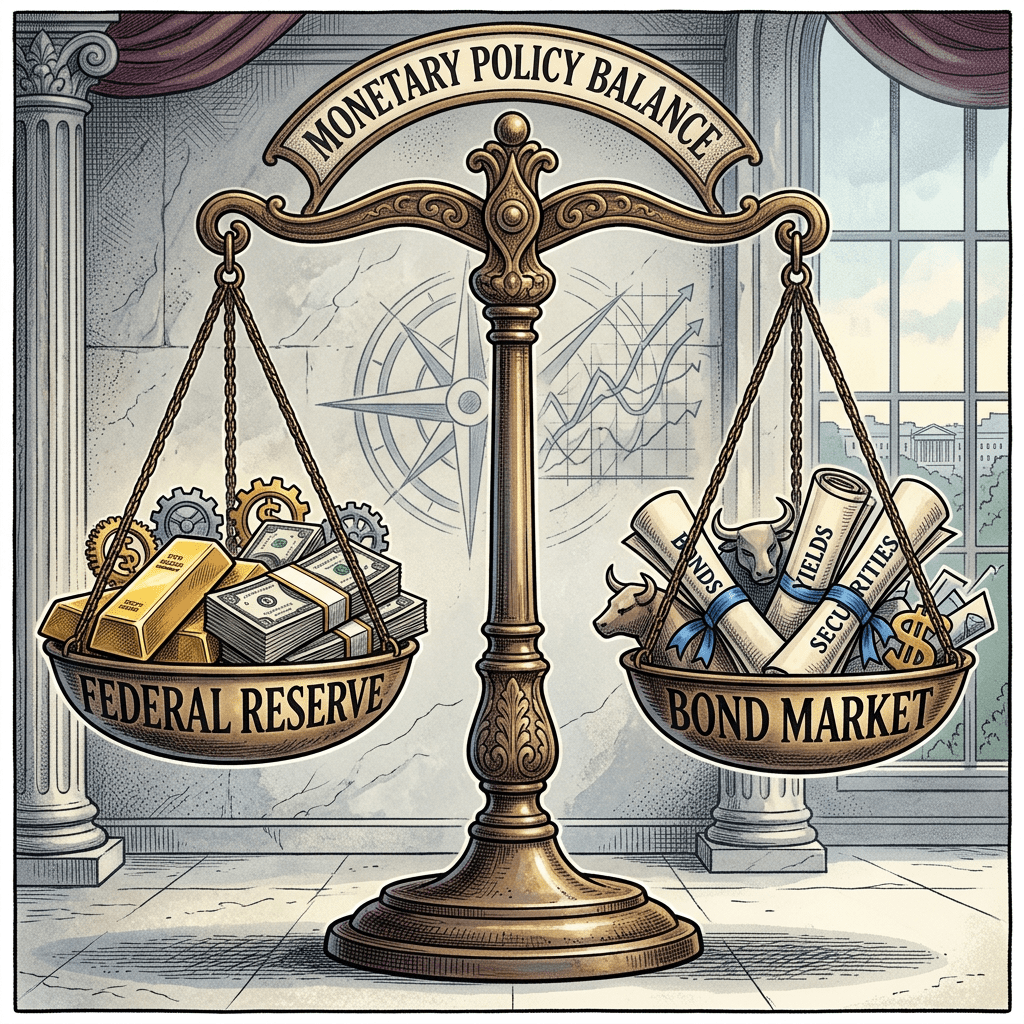
The Fed does not set interest rates.
That may seem contradictory at first, since when we mention rates now, we mention the Fed too. But this is a common misconception, one that’s imperative to understand to grasp the most important set of numbers in finance.
So, What Does the Fed Actually Do?
To understand interest rates, we need to understand the Fed and how it controls monetary policy. Ignoring the money supply, the Fed sets the discount rate. This is the interest rate at which banks across the country can borrow money from the Fed. However, the Fed would rather have banks borrow from each other before coming to them. Therefore, that lending is represented by the Federal Funds Rate, which sits below the discount rate.
That’s why the Fed doesn’t actually have a set rate. It issues a range instead (called its “target”). Right now, the Fed rate target is between 3.50% and 3.75%. The discount rate is always the ceiling (3.75%), while the Federal Funds Rate sits in the range (currently at 3.62%). Where in the range the funds rate sits is determined by daily lending volume and published at 9:00 AM every morning.
This is important because the Federal Funds Rate is also known as the Overnight Rate. After all, banks lend money to each other daily. This is because one bank might realize it may not have enough money to cover withdrawals the next day, while another realizes it has an excess.
But this overnight rate is not the interest rate that you get on loans for a car or your mortgage. It’s not the interest rate private equity firms get for their LBOs, either. The real interest rates are set by the bond market.
The Bond Market: The Real Driver of Interest Rates
The rate that the Fed sets acts as a baseline for the bond market, and everything else builds on top of it. But the Fed’s influence does not stop at that baseline. It also shapes the market through expectations. A hawkish Fed signals higher rates ahead, and investors respond immediately rather than waiting for the hike to actually happen. Demand for existing bonds falls since newer bonds will soon offer better yields, and that drop in demand pushes yields up in the short term. This effect often compounds with inflation itself. Higher inflation tends to both prompt hawkish Fed signaling and independently push up yields, since investors demand more compensation to avoid losing purchasing power over the life of the bond.
But outside of that, the Fed doesn’t have a large impact on yields. All of that is the mechanics of supply and demand within the bond market. Demand and yields are inverse. When there’s less demand, yields rise, and vice versa. Essentially, the bond market (in the context of the US government) is a way for individuals or corporations to buy debt from a risk-free borrower. Since individuals like you or me also take out debt, we pay back at rates that stem from this same market. An individual carrying lower risk, and therefore a higher credit score, would normally pay an interest rate closer to the underlying yield. One carrying a higher risk would pay a wider spread above it. This relationship is clearest in mortgages, which track the US 10 Year Treasury Yield closely since both are long in duration and the spread mainly reflects prepayment and credit risk.
Other debt follows a looser version of the same logic. Short-term loans (credit card, etc.) follow metrics that track closely to the federal funds rate, but every borrower pays some spread over a risk-free baseline, and that baseline ultimately comes from the bond market.
Why Interest Rates are Important
For average consumers, higher rates mean higher borrowing costs across the board, from mortgages to auto loans to credit cards. That shapes how much housing someone can afford or whether a car purchase gets pushed back a year. Businesses feel this too, but the effect compounds for early-stage companies. A young company burning cash to grow often needs external financing to survive, and a higher-rate environment makes that financing more expensive at the exact moment default risk is climbing. That combination can turn a manageable capital raise into a larger problem.
Banks sit on both sides of this dynamic. Higher rates mean banks earn more on the loans they issue, which lifts net interest margins and revenue. But that same rate environment increases the odds that borrowers fall behind on payments, so banks are simultaneously collecting more per loan and facing more delinquencies. Whether higher rates help or hurt a bank’s bottom line often comes down to which effect dominates.
The stock market feels rate changes just as directly. Equity valuations are built on discounted future cash flows, and a higher rate means a higher discount rate applied to those future earnings. The result is compression in what those future cash flows are worth today, which is part of why growth stocks in particular tend to sell off when rates rise. Asset managers face the same pressure from another angle, since the assets they manage are valued against the same compression. This can weigh on their own equity value, along with the portfolios they run.
Currency and commodity markets round out the picture. Higher yields normally attract foreign capital seeking better returns on dollar assets. More demand strengthens the dollar (see my ForEx article to learn more!). A stronger dollar makes commodities priced in dollars, like gold, more expensive for holders of other currencies. This dampens demand and puts downward pressure on price (part of why gold has seen a sell-off this year).
What to Take Away
Interest rates are the starting point for a chain reaction that touches every corner of the economy. From the discount rate down to the bond market, every mortgage, loan, currency, and company takes notice. Every part of this system feeds into the next. Understanding where a rate comes from and why it moves is what separates reacting to headlines from actually understanding the market underneath them. When a Fed decision is in sight, the headline number is only part of the story. What’s more important is everything it sets in motion.
Disclaimer:
This blog post is for educational and informational purposes only. It is not financial advice. I am not a licensed financial advisor, and nothing in this post should be interpreted as a recommendation to buy or sell any securities. Trading involves risk, and results are not guaranteed. Past performance is not indicative of future results. Always do your own research and consult with a licensed financial professional before making any investment decisions. None of my statements or points of view are reflective of the views of Deep Knowledge Investing.


Leave a Reply